
Capital Growth vs Rental Yield: What Should You Do?
When it comes to property investment, one of the most common questions investors ask is:
Should I focus on capital growth or rental yield?
The answer isn’t black and white. There is no single “correct” strategy—the right approach depends on your financial position, investment timeline, and long-term goals.
Once you’ve done your research and understand what suits your situation, Growing Real Estate can help you find the right investment property to achieve your goals.
Understanding Your Property Investment Goals
Before purchasing an investment property, it’s important to ask yourself:
Are you investing for income now, or growth for the future?
Your answer will influence every decision you make, including:
- Your investment budget
- The location and property type
- How long you can hold the property
- Your ability to manage the investment without financial stress
The Simple Breakdown
Capital Growth
The increase in a property’s value over time.
Rental Yield
The rental income a property earns, expressed as a percentage of its value.
Both strategies can build wealth—but they work in different ways.
Rental Yield Explained
Rental yieldis the income earned from an investment property.
Owning a rental property is similar to running a small business—you need to ensure the numbers make sense.
Example: Rental Yield
- Property purchase price: $500,000
- Weekly rent: $500
- Annual rent: $26,000
Gross Rental Yield:
($26,000 ÷ $500,000) × 100 = 5.2%
If annual expenses (rates, insurance, maintenance, management) total $6,000:
Net Rental Yield:
($26,000 − $6,000 ÷ $500,000) × 100 = 4%
Key Factors When Investing for Rental Yield
- Rental demand and quality
- Location and amenities
- Return on investment
- Ongoing expenses and cash flow
Higher rental yield properties are often attractive to investors seeking steady income or reduced holding costs.
Capital Growth Explained
Capital growth refers to how much a property increases in value over time.
This strategy suits investors focused on long-term wealth creation rather than immediate income.
Example: Capital Growth
- Purchase price: $600,000
- Property value after 10 years: $850,000
- Capital growth achieved: $250,000
While rental income may only cover part of the expenses during ownership, the value is realised when the property is sold or refinanced.
Important Considerations for Capital Growth
- Interest rates and loan structure
- Holding costs over time
- Ability to maintain ownership during market cycles
Positive vs Negative Gearing
Positive gearing occurs when rental income exceeds expenses.
This strategy is often suitable for investors who:
- Want rental income to supplement their earnings
- Prefer lower financial risk
- Own the property outright or have minimal debt
Negative gearing occurs when expenses exceed rental income.
While this means the property operates at a loss, it can be beneficial for investors seeking to offset taxable income, depending on personal circumstances.
Whether negative gearing is advantageous depends entirely on your investment purpose and financial strategy.
Which Strategy Is Right for You?
There is no universal answer. The best property investment strategy is the one that:
- Aligns with your financial goals
- Matches your risk tolerance
- Fits your lifestyle and timeline
By understanding the difference between capital growth and rental yield, you can make informed, confident decisions about your property investment journey. you can make informed, confident decisions about your property investment journey. you can make informed, confident decisions about your property investment journey. you can make informed, confident decisions about your property investment journey. you can make informed, confident decisions about your property investment journey. you can make informed, confident decisions about your property investment journey.
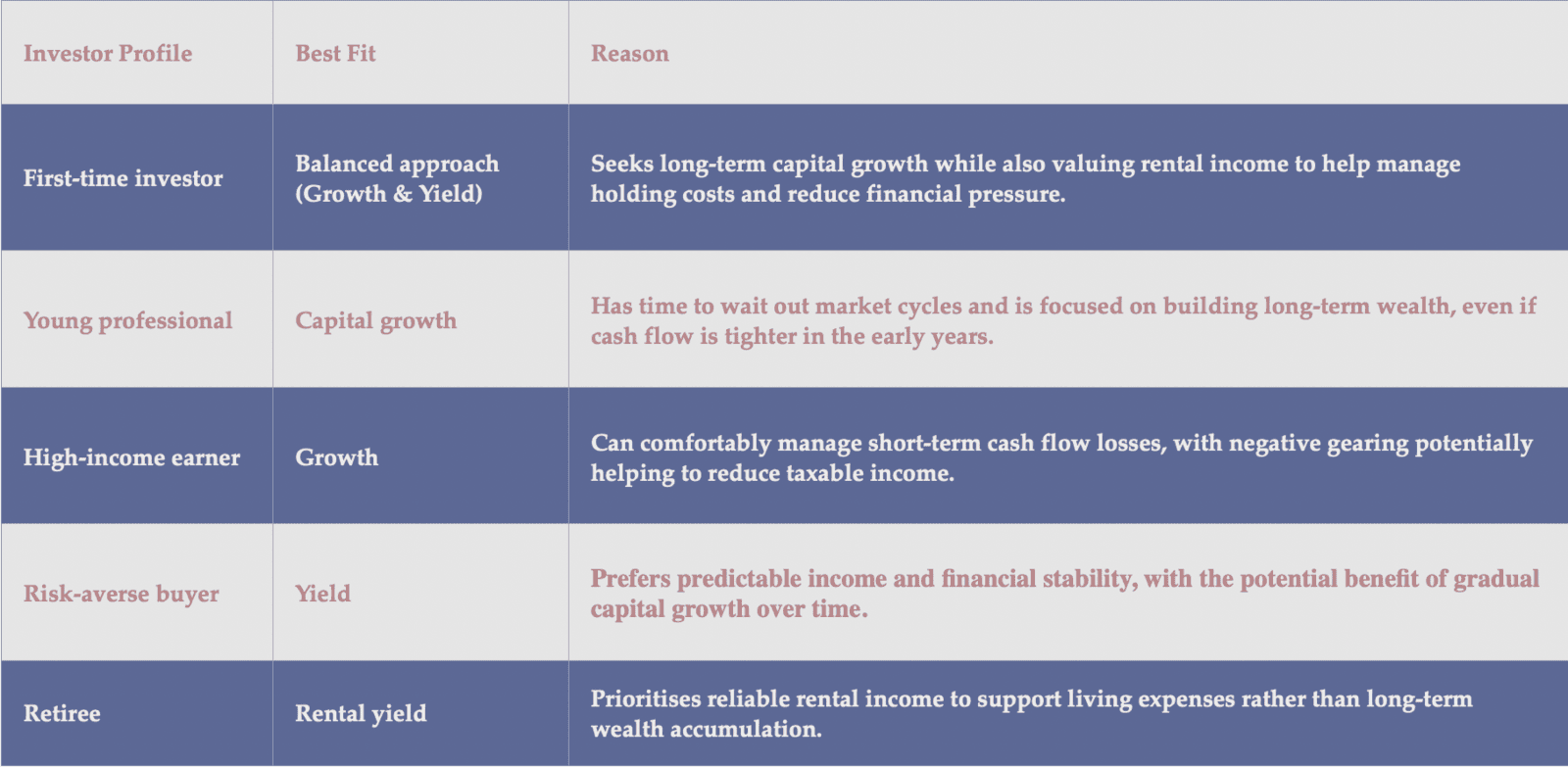
Every investor’s situation is different. The table below outlines how capital growth and rental yield may align with common investor profiles.
When you’re ready, Growing Real Estate is here to help you find the right property to support your future.
Disclosure
Please consult with qualified accountants, financial advisors, and lending specialists before investing in property. The information provided is based on industry experience and research and is accurate to the best of our knowledge.